However, this two-circle model revealed its limitations as it failed to take share ownership into account. Thus, in the late 1970s, the three-circle model was born, adding the ownership/shareholder circle to those of the business and the family..
The seven territories
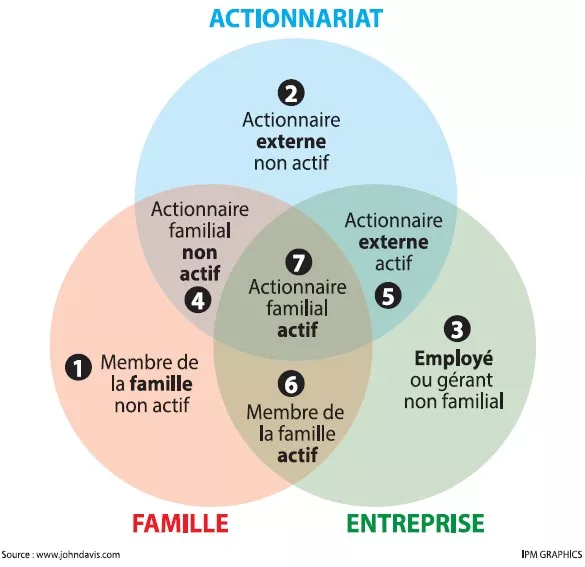
The system reveals its full utility through its overlapping areas. The intersection of these three circles forms seven distinct zones (or territories), which make it possible to analyze the differing perspectives of family members, shareholders, and company employees, summarized as follows :
-
Non-active family members hold ambivalent feelings toward the business. This might be the founder's spouse or another family member. Both the company's long-term survival and family harmony matter deeply to them. How can a balance be struck between family life and corporate prosperity?
-
External shareholders (investors) focus primarily on financial considerations. What will my return be? Am I receiving sufficient information? How will I eventually exit my investment?
-
Non-family employees, who may hold any position within the organization, are mainly concerned with job security and career progression. Is there a risk that nepotism will limit my advancement opportunities? Will my merits be fairly rewarded?
-
Non-active family shareholders, who can be described as "patient capital" holders, share the concerns of both groups 1 and 2.
-
Active external shareholders, such as key managers awarded shares for their performance, care about company prosperity while sharing the financial questions of group 2.
-
Family members working in the business without owning shares care about their career growth while keeping a close eye on family harmony. They may also aspire to become shareholders.
-
Active family shareholders—frequently the CEO/owner, but sometimes other relatives as well—carry the interests of all groups. Wearing multiple hats, they must manage the expectations of all three circles while taking care not to burn out.
The circles are dynamic
It is worth noting that these three circles are not static. Individuals can move from one territory to another over time. For example, a child may become a shareholder through inheritance and subsequently become active (or remain inactive) in the business. Similarly, when a owner-manager reaches the end of their career, they may become a non-active shareholder or exit equity ownership altogether.
The relative size of each circle can also evolve over time. Certain circles may gain greater weight—for instance, if the family grows faster than the business can provide employment, or conversely, if the company grows significantly while only a few family members remain involved.
A time-tested model
Since its publication over 40 years ago, the three-circle model has become an industry benchmark. Taught extensively in business schools, it is valued for its simplicity while successfully conceptualizing a vast array of scenarios. The neutrality of the framework helps de-escalate tensions in family enterprises, allowing everyone to see where they fit and to understand the equally legitimate interests of others. Indeed, it is fascinating to observe how accurately a person's behavior can be anticipated simply based on their position within one of these territories.
(*) The Three-Circle Model of the Family Business System was developed by Renato Tagiuri and John Davis at Harvard Business School starting in 1978. More information available at
Article originally published in La Libre Économique by Tanguy della Faille, Partner at Fondaris, on 02/11/2023. Published/updated version on the Fondaris website with the author's permission.
