In this gloomy context, many believe that our M&A advisory firm is overwhelmed with requests. Yet, the economic crisis actually makes our work more difficult due to the tightening of bank credit and prospective buyers' hesitation to commit based on business plans that have become uncertain. Sellers are also fewer in number, preferring to wait for better days to fetch a higher valuation for their company.
There is therefore great confusion between the different ways a company stops or transfers its business. Semantics do not help, as only two letters distinguish these two realities. In substance as well, a clear distinction must be made, because the legal and tax regime of a business closure (cessation) has nothing to do with that of a business sale (cession).
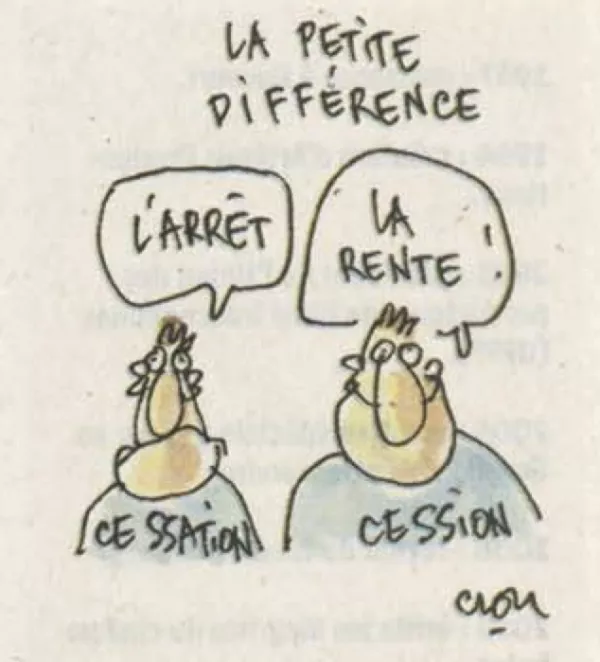
The closure (cessation) or liquidation of a company implies the complete shutdown of activity, the sale of realizable assets, and ultimately, the strike-off of the company, which loses its legal personality. It is therefore a radical option, often perceived as a failure or at least as a last resort. However, voluntary liquidation is preferable to filing for bankruptcy. In the latter scenario, one no longer controls one's own destiny: it is the court-appointed receiver (curateur), under the supervision of the commercial court judge, who organizes the liquidation. When a company has lost all reasonable hope of returning to profitability, it is thus better to organize a voluntary liquidation under good circumstances rather than digging an increasingly deep hole only to ultimately face a forced liquidation anyway.
Tax-wise, liquidation surpluses—meaning the remaining balance of assets minus liabilities after the repayment of share capital—are currently taxed at 10%. This relatively attractive rate will likely be revised upward in an upcoming tax reform to bring it closer to withholding tax rates (currently at 15% or 25%). Note that there is an interesting alternative to closure when a company faces temporary financial difficulties.
The Law of January 31, 2009, on the Continuity of Enterprises (LCE) replaces judicial reorganization (concordat), which too often resembled the "antechamber of death." A company in distress is placed under court protection, sheltered from its creditors for several months. Subsequently, provided certain conditions are met, it can resume its operations normally. One should not hesitate to leverage the LCE while there is still time.
A business sale (cession), on the other hand, aims to transfer ownership of a company—usually a thriving one—to a buyer. The transaction price reflects the company's profitability, as the buyer seeks to achieve a sound return on investment. Consequently, the ideal time to sell is when the business is generating strong profitability.
The sale process is therefore a voluntary and positive decision by a leader wishing to hand over their "baby" in good health to an acquirer who will take care of it. This is the complete opposite of a closure! The taxation of a sale depends on the chosen legal structure. An asset sale (cession de fonds de commerce) is taxable at the corporate tax rate (33.99%). Conversely, a sale of shares or stock is not taxed in Belgium, provided the transaction is conducted within the context of managing private wealth ("dans le cadre du patrimoine privé").
A recent ruling by the Brussels Court of First Instance (February 16, 2011) confirmed that the sale of a business by its owner-manager is deemed to fall within the scope of managing private wealth.
Unfortunately, this favorable regime is unlikely to last much longer. Many political parties no longer hide their intent to tax capital gains on shares, grounding their arguments on the indecency of untaxed stock market gains. This ignores the fact that such a change in our country's tax framework, should it come to pass, will certainly have significant and detrimental consequences for the transfer of family businesses, as I previously discussed in these columns a few months ago.
Yet, it appears to be solely due to the absence of a fully empowered government that this tax reform has not yet seen the light of day. Let us hope that our future government will make the distinction and not lose sight of the importance of maintaining prosperous SMEs within our territory. For these companies, succession is a key milestone—transferring to a buyer who, taking on significant personal risks, commits to preserving the business and its jobs.
While in a closure by way of voluntary liquidation, the business leader remains in control of the process, it still means ending the business, which is hardly rewarding. A sale, by contrast, is an act intended by the seller so that their company can continue its journey in the hands of a qualified acquirer. As long as the business owner—and their business—remains in good health (the two often go hand in hand), they have every incentive to plan a sale (cession) rather than suffer a closure (cessation).
Illustration: Clou
