This duty of care, deeply embedded in Anglo-Saxon law, already existed in Roman law. The maxim "Caveat emptor" ("Let the buyer beware") clearly defines the roles: it is up to the buyer to exercise caution, as they cannot fully rely on the seller, who will naturally try to present the company in its best light. A prudent buyer, while conducting due diligence, will therefore want to review as many documents as possible to confirm the target company's proper management and ensure there are no hidden surprises.
However, the requested files are often highly confidential, especially when the prospective buyer is a direct competitor. Consequently, sellers are understandably hesitant to reveal their inner workings before the deal is finalized.
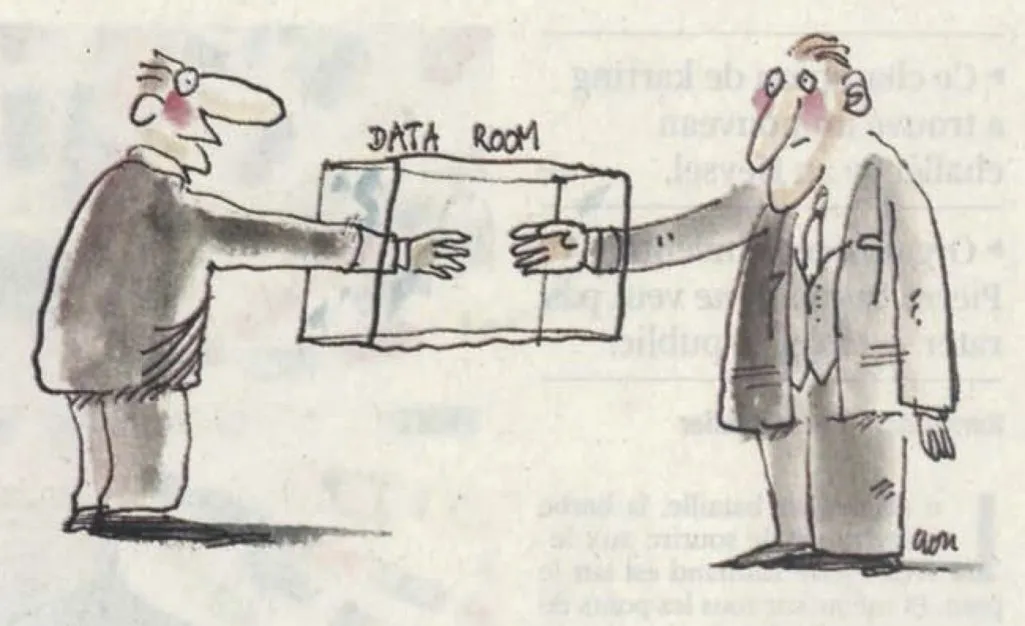
In this delicate situation, a data room provides an effective solution. By centralizing all relevant information in a secure location, access and distribution can be strictly controlled. As a rule, a data room remains open for a defined timeframe, and access is restricted to specifically designated advisors and parties.
A data room can be either physical or virtual. In a physical data room, all information is stored on paper inside a dedicated room. This often involves dozens of binders containing a vast volume of documentation: accounting records, commercial contracts, HR data, market analysis, competitor insights, asset inventories, stock levels, and more.
The ground rules for review are agreed upon in advance: no photocopying, no photos, one team in the room at a time, visits by appointment only, and so forth.
This traditional setup can be cumbersome to arrange, forcing advisors to travel to the site, which is far from ideal. Furthermore, absolute confidentiality remains hard to enforce. That is why virtual (or electronic) data rooms are largely preferred today. These secure cloud platforms make it possible to manage granular access permissions while maintaining an automated audit trail of user activity.
While some law firms and accounting practices have built their own internal platforms, there are also specialized online providers offering advanced features such as robust technical security, legal compliance, standardized due diligence checklists, and multi-language support.
A virtual data room ensures that all bidders access the exact same information simultaneously. Viewable remotely, it can be updated electronically with ease. Access permissions can be configured down to the finest detail—monitoring who viewed which document and when. Document traceability is often enforced via automated watermarks that display the reader’s identity—a powerful deterrent against violating non-disclosure agreements.
Data rooms are used as a matter of routine in large-scale transactions. For SMEs, their adoption is growing, though they should still be used with discretion. When confidentiality is less of a concern (for instance, when dealing with a non-competing buyer), simply granting access to existing corporate files may prove far more efficient.
A small physical data room can also be easily organized at the offices of the company's accountant, lawyer, or M&A advisor. Indeed, one should not underestimate the effort involved in launching a virtual data room: scanning, sorting, and indexing hundreds of documents is a painstaking task. Moreover, as business documents evolve, they must be continuously updated.
Whatever path the seller chooses, one piece of advice stands out: when preparing to sell a business, it is best to perform an internal audit beforehand. This "vendor due diligence" helps uncover potential weaknesses early on, preventing unexpected surprises in the middle of negotiations while laying the groundwork for a smooth virtual data room setup.
Illustration: Clou
