The withholding tax on liquidation surpluses was in reality the last tax benefit enjoyed at a reduced rate. This relative leniency was historically justified by the principle that liquidating a company should not be overly penalized, as these amounts consist of profits that have already been subject to corporate income tax (currently 33.99%). Likely for the sake of consistency, this withholding tax on liquidation surpluses will therefore be aligned with the "standard" 25% rate.
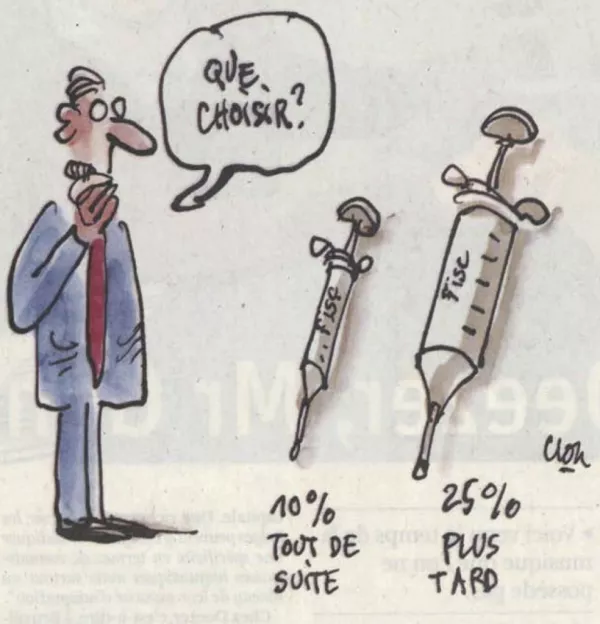
However, lawmakers sought to establish a transitional period, aiming at the same time to encourage capital increases—the financial cushion of any business. Thus, it is permitted to tax accumulated company reserves at a 10% rate by incorporating them into equity, without requiring the company to be liquidated. Simply put, it means paying 10% now instead of 25% later.
So, should one seize this opportunity and extract excess liquidity at all costs using this preferential rate? And how does this apply if a business transfer is being considered?
Let us first examine the conditions set out by lawmakers for the transitional scheme outlined above:
-
Eligible reserves: These must be taxed reserves existing as of March 31, 2013. Annual accounts approved by a general meeting prior to that date must therefore be taken into account when calculating eligible reserves;
-
Capital incorporation: The full amount benefiting from the reduced 10% rate must be incorporated into share capital. This step requires a formal notary act and publication in the Belgian Official Gazette (Moniteur belge);
-
Timeline: The capital increase must take place during the final financial year closing before October 1, 2014. For companies with a financial year ending on December 31, the payment of the withholding tax was due by January 15, though the execution of the notary act is permitted until the end of March 2014;
To avoid triggering anti-abuse provisions, a lock-up period is enforced—four years for SMEs and eight years for large companies. During this period, the amount incorporated into capital cannot be distributed without incurring an additional tax, which would significantly reduce or entirely wipe out the initial tax benefit.
As we can see, this transitional measure, attractive as it may be, comes with processing costs and specific constraints. For most companies operating on a calendar fiscal year (ending December 31), it is already too late to take advantage of this mechanism.
In the context of a company currently undergoing a business transfer, the following alternative should be evaluated. If available reserves have neither been distributed nor capitalized, the buyer can leverage them within their acquisition financing structure. Indeed, the Participation Exemption regime (Régime des Revenus Définitivement Taxés or RDT) allows a holding company to exempt 95% of the dividends received from its subsidiary from tax. Available reserves can thus be pushed up to the parent entity at an effective tax rate of just 1.7% (33.99% × 5%), which compares very favorably to the 10% rate described above.
From a "simple" tax rate harmonization to 25%, the practical implementation of this measure gives rise to numerous questions when determining the most tax-efficient route. As is so often the case in legal and tax matters, every deal structure is unique and requires a tailored approach. Obtaining guidance from specialized advisors is therefore essential.
Illustration: Clou
