The sale of a business can be a source of anxiety for those who make a living from it, especially when they are not well informed. Thus, employees sometimes find out through the press that their employer has changed. It is therefore legitimate to ask whether employees have a right to information in the event of a sale, and how far this right should extend. French lawmakers took a clear stance by protecting employees. Promulgated on July 31, 2014, and having entered into force last November 1, this "Hamon Law" provides us with an opportunity to take stock of the issue.
Why the Hamon Law?
The relevant provisions are part of a broader set of measures on the Social and Solidarity Economy (ESS Law, Arts. 18–20), championed by former minister Benoît Hamon. Observing that many healthy companies failed to find a buyer, it seemed useful to give employees the opportunity to make an acquisition offer. Employee ownership enjoys genuine success in France, particularly through cooperative and participative societies (Sociétés coopératives et participatives or Scop).
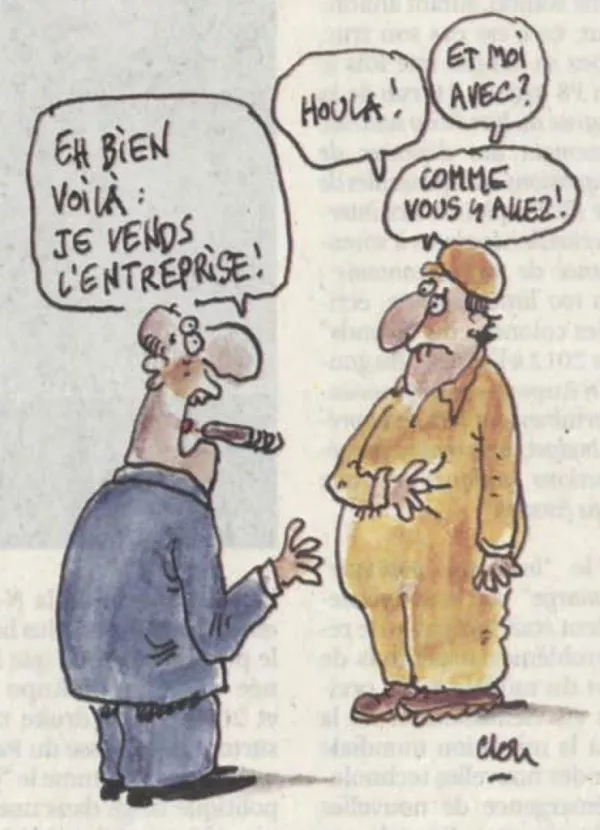
What does this right to information consist of?
Employees must be informed of the intention to sell the company or the business assets within two months prior to the sale, so that they have the opportunity to submit a buyout offer. The notification can be made through various forms (meeting, letter, email), but each employee must be informed individually, which requires an acknowledgment of receipt. The law does not mandate the disclosure of specific details (price, etc.), but it invites employees to seek guidance from a professional, such as the Chamber of Commerce. The obligation to inform applies to any company with fewer than 250 employees, noting that large companies, which have a structured union representation, are subject to specific provisions.
What are the consequences for business transfers?
The penalty for non-compliance is particularly severe, as the sale can be annulled at the request of any employee. Furthermore, numerous questions remain unresolved, while the implementing decree was only published on October 28, 2014—just 3 days before the law came into force. It should also be noted that the duty to inform is retroactive, which is very problematic for all transactions currently under negotiation.
The law imposes a duty of discretion on informed workers, but it is legitimate to question how this could be monitored. It indeed seems risky to derogate from the sacred principle of confidentiality that surrounds sale negotiations.
In this context, a strong backlash emerged from both employer organizations (MEDEF) and business transfer professionals.
The legal uncertainty caused by this law is compounded by an exceptionally gloomy business climate. The number of transactions experienced a sharp surge in October, raising fears of a sudden standstill once the new law was implemented. There is, in fact, open discussion of backtracking or significantly weakening the scope of these provisions.
What is the situation in Belgium?
The Law of April 23, 2008 mandates that employees be informed in companies that have a CPPT (Comité pour la Prévention et la Protection au Travail) or a Works Council (Conseil d'Entreprise). The right to information covers annual information (annual accounts) as well as "basic" information, which notably includes agreements or covenants that have fundamental and lasting consequences on the company's situation. Cases involving a business transfer fall under this provision, just like the signing of a major contract, financial difficulties, etc. In the event of non-compliance, criminal sanctions apply, ranging from fines to prison sentences, though it appears they are rarely enforced.
This framework is in reality the transposition of European Directive 2002/14/EC. Similar provisions therefore exist in all European Union countries, applicable to companies with union representation.
For SMEs that do not have union representation (fewer than 50 employees), there are no specific constraints regarding employee notification.
In conclusion, excess in anything is harmful. While it seems important to properly inform employees about their future, this right must not become an obstacle to the smooth execution of SME transfers, a process that is already highly delicate.
