Yet, the legislature has established specific protection for business transfers. Collective Bargaining Agreement No. 32 bis of June 7, 1985 (Convention collective de travail n°32 bis) provides for the safeguarding of employees' rights when a company is transferred in whole or in part. This protection applies to share transfers as well as asset transfers (cessions de fonds de commerce). In the case of an asset transfer, employees receive an addendum to their employment contracts confirming the change of employer and the preservation of their salary, seniority, and other social rights.
The change of employer in itself is therefore not a valid ground for dismissal. No employee can be dismissed under the pretext of facilitating the transfer of the business. This prohibition on dismissal applies to both the transferor (seller) and the transferee (buyer).
CCT 32 bis also provides for an obligation of information and consultation. For the companies concerned, the employer must inform the works council (conseil d'entreprise) in advance regarding the economic, financial, and technical reasons for and consequences of the transfer. Furthermore, the employer must consult the works council on the measures to be taken to avoid layoffs (social measures, prompt re-hiring).
However, it remains naturally possible to dismiss an employee for serious cause (motif grave) or for economic, technical, or organizational reasons. In the event of a dispute, the burden of proof rests on the employer to demonstrate to the court that the dismissal was unrelated to the transfer. A manager failing to comply with these provisions may be liable not only to administrative fines but also to criminal sanctions.
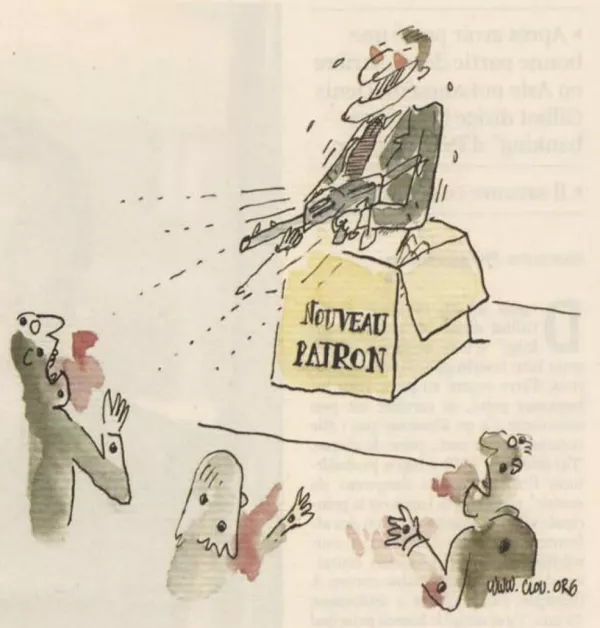
Beyond this legal framework lies reality. And the reality of family-owned SMEs is vastly different from the scenario described at the beginning of this article. The manager of an SME obviously aims for the long-term profitability of their business. However, they will not take radical short-term measures merely to boost financial ratios. On the contrary, they have often forged strong personal ties with their team and understand that success does not depend on them alone. Most sales of family businesses are therefore carried out smoothly and continuously. The buyer needs key personnel to ensure operational continuity. And in an SME, every individual counts! We are thus far removed from the cliché mentioned at the outset.
Illustration: Clou
