The business plan is divided into two parts: the quantitative section (the financial plan) and the qualitative section (the project description).
The financial section is structured much like a company's annual financial statements: balance sheet, income statement, and cash flow statement. Building on historical data, the plan incorporates specific operational assumptions: revenue growth, margin trajectory, evolution of other overhead costs, future capital expenditure (capex) requirements, and more. From these parameters, projected financial statements are generated, yielding net income figures and detailed performance ratios. It is essential to understand the project's operational flexibility and compute its breakeven point—the threshold at which the business begins to generate a profit.
The selection of underlying assumptions is therefore crucial.
Professionals often create multiple versions of the financial plan: an optimistic scenario (best case), a pessimistic scenario (worst case), and sometimes an intermediate baseline (medium case). Management's assumptions will be carefully scrutinized and frequently challenged; it is therefore essential to back them up with solid evidence.
The qualitative section contains a detailed overview of the company: its history, founders, core business, production assets, personnel, internal organization, product or service offerings, market landscape, competitive environment, as well as its customer and supplier base. This information must directly support the numbers presented in the financial plan. The goal is to maximize the credibility of the financial projections through precise arguments. The quality of the presentation is equally important, as the objective is not only to inform the reader but also to persuade them.
Furthermore, a business plan enriches discussions around corporate valuation. Most traditional valuation methods rely strictly on a company's historical performance—which is akin to driving a car while looking solely in the rearview mirror. In contrast, the Discounted Cash Flows (DCF) method is forward-looking, determining value by discounting projected future cash flows to their present value.
In certain situations, business plans can lead to excesses. When capital is abundant, analysts lack critical skepticism, and assumptions become detached from reality, the combination proves explosive. This dynamic notably fueled the dot-com bubble of the early 2000s, when numerous startups secured massive funding based on impressive yet completely unrealistic business plans. Another pitfall is spending too much time drafting the plan to the detriment of managing actual operations. One must never forget that real business is not built inside an Excel spreadsheet, but out in the field!
In many cases, seeking professional assistance can be highly beneficial. However, this choice does not relieve the business owner of the need to be deeply involved in the process; otherwise, the plan risks becoming disconnected from operational realities. For anyone looking for concrete guidance to build a business plan, free templates for both the quantitative and qualitative sections are readily available online.
Ultimately, the business plan remains an indispensable tool for making informed decisions on any corporate initiative. It translates strategic and operational choices into clear financial projections, and the credibility of its underlying assumptions will ultimately determine its success in convincing key stakeholders.
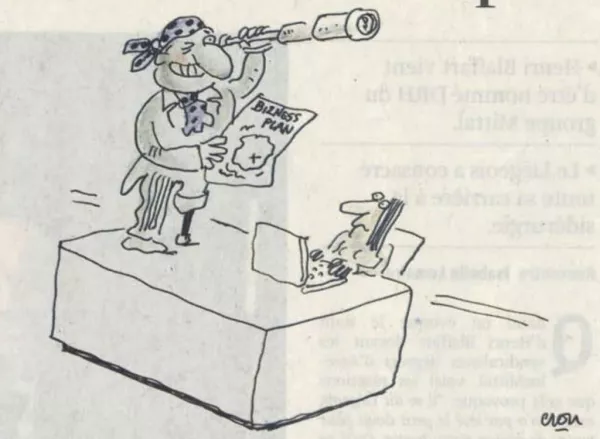
Illustration: Clou
